
The particle problem
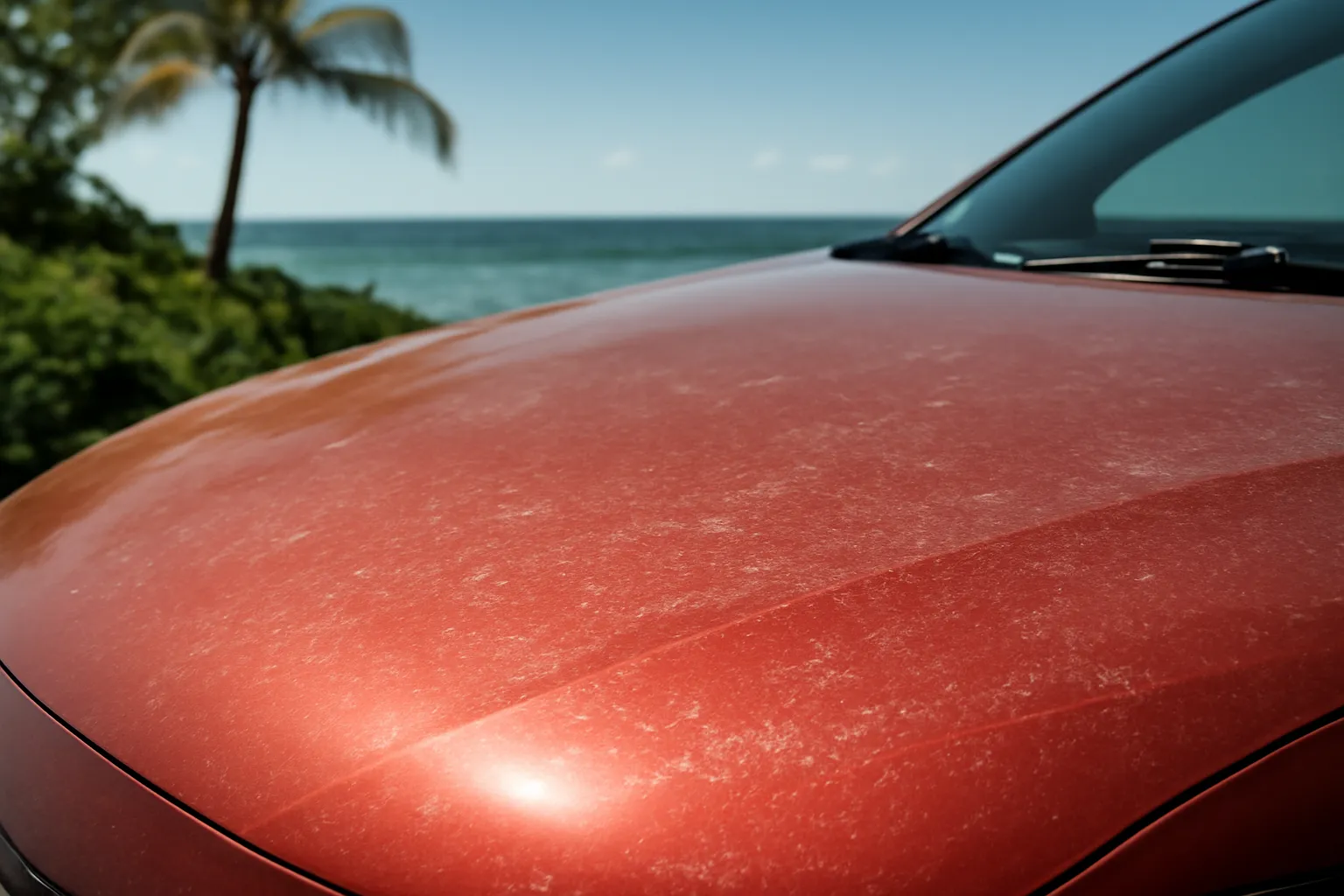
After a major eruption of Piton de la Fournaise, ash deposits settle across vehicles throughout Réunion. Most drivers reach for a hose or a sponge. Both choices can cause more damage than the ash itself.
Volcanic ash particles have angular, abrasive edges. When dry, they behave like a fine-grit cutting medium. Dragging a sponge or a chamois leather across a panel covered in dry ash applies those edges directly to the clear coat under pressure — producing fine scratches and swirl marks.
Why rinsing first is non-negotiable
A high-pressure rinse removes ash without contact. The ash is lifted and carried away before any physical contact is made with the surface. Only once the ash is removed should any washing tool touch the paint.
This is why the two-step wash process — high-pressure rinse first, then hand wash with fresh solution — is not a luxury. It is a basic requirement for island conditions.
What happens when this isn't followed
Under direct lighting, volcanic ash damage produces the same pattern as tunnel-wash damage: fine circular scratches, most visible on flat horizontal panels (roof, bonnet, boot lid) where ash accumulates most heavily.
Over repeated incidents, this accumulates. Paint that showed depth and gloss when the vehicle was new develops a flat, hazy quality — not from age, but from accumulated micro-abrasion.
What you can do
- Rinse before any contact washing after volcanic activity
- Use the two-bucket safe-wash method, not a sponge from a bucket of dirty water
- If swirl marks have already accumulated, machine polishing can correct them
- A ceramic coating reduces contamination adhesion, making post-eruption cleaning faster and safer
Our online course covers safe wash methodology for island conditions in detail — including the specific risks of volcanic environments that no mainland course addresses.